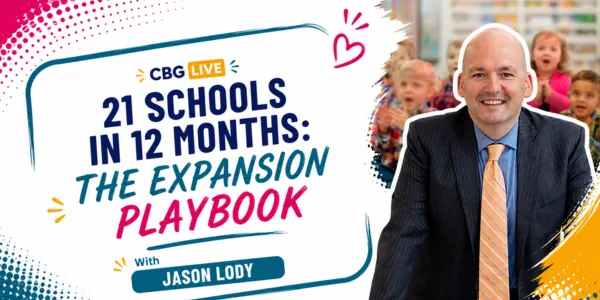
21 Schools in 12 Months with Jason Lody
231 Locations in 12 Months: What Scaling Really Looks Like
With Jason Lody
Most founders think growth is straightforward. Get more customers, open more sites, hire more staff, watch the revenue line go up.
Then fast growth actually hits, and everything grinds to a halt.
Jason knows this dynamic well. He launched his first preschool simply because he could not find a good one for his own son. He grew that single site into a full portfolio, which KinderCare eventually acquired. Later, he founded Aventus Education. That business exploded to 23 locations across six states in just 12 months, supported by roughly 300 employees.
Speaking at CBG Live, Jason was clear about one thing: he does not expect every entrepreneur to move at that pace. But he insists that rapid growth is only possible if your company is built to be copied.
Build systems before expanding
Scaling a company starts with the unglamorous work of setting up systems.
If a business relies on the founder knowing how every small task gets done, it will not scale. Processes need writing down. Expectations have to be clear. Staff must understand daily operations without calling you every five minutes.
That means putting everything on paper, from routine tasks and employee expectations to core values and quality standards.
The premise is simple enough. If your company only functions when you are in the room, you do not own a scalable business. You just own a demanding job.
Grow by taking over existing operators
Expanding does not mean building every new branch from scratch.
Jason got his first major expansion break when a nearby competitor was about to lose its operating licence. He reached out to the landlord, negotiated a lease transfer, and stepped in. Families and staff stayed put. His new licence took effect right as the old operator pulled out, taking him from one location to two instantly.
Not long after, a real estate developer bought a property but had no interest in running the school inside it. Jason took over operations in exchange for a lease.
Within 18 months, he had three locations running.
The takeaway is not just to buy up competitors. It is about spotting unconventional opportunities right in front of you.
Growth beyond physical footprint
Adding physical sites is only one way to scale.
At CBG Live, Jason highlighted several alternative growth models:
Licensing proprietary curriculum or operating software
Launching online services
Franchising the entire brand
Licensing the operational setup without using the brand name
Licensing delivery framework systems
Setting up strategic partnerships
Offering staffing services
Pursuing targeted acquisitions
Adding complementary services and new revenue channels
This shifts your mindset away from asking how many physical doors you can open. Instead, ask: what internal assets have I created that someone else would pay to use?
Your curriculum, workflows, and internal training might have standalone value. Commercialising existing assets lets you scale revenue without taking on the overhead of another building.
Why vacant buildings are trap doors
Taking over empty properties comes with hidden operational traps.
Jason has taken over dark sites before, including buildings left empty by failed operators. But vacant real estate often brings massive unexpected costs.
Once a site goes dark, older grandfathered zoning rights or regulatory approvals often vanish. Updated fire codes or new building requirements can suddenly force major capital expenditures before you can even open the doors.
That is why Jason prefers acquiring active operations. An operating business comes with working teachers, enrolled kids, existing infrastructure, local reputation, and immediate cash flow. You might need to rebrand or fix operations, but you start with an engine that is already running.
Create an independent operating model
Jason's expansion to 23 locations was not a stroke of luck. It was the result of heavy preparation.
To grow like that, a business needs documented procedures, well-trained teams, defined standards, and repeatable routines.
Most importantly, the operational model must function without the founder manually holding all the pieces together. That is what stops a rapidly growing business from collapsing under its own weight.
The test of true scale
Scaling is not just about expanding your footprint. It is about creating a model that repeats reliably.
Before opening your next site, hiring another manager, or launching a new line of business, ask yourself one question: could an outsider run this operation exactly as you would?
If the answer is no, hold off on expanding. Focus on documentation first.
Real scale is not measured by how much you can handle while working long hours at the office. It is measured by how well the business grows when you walk away.